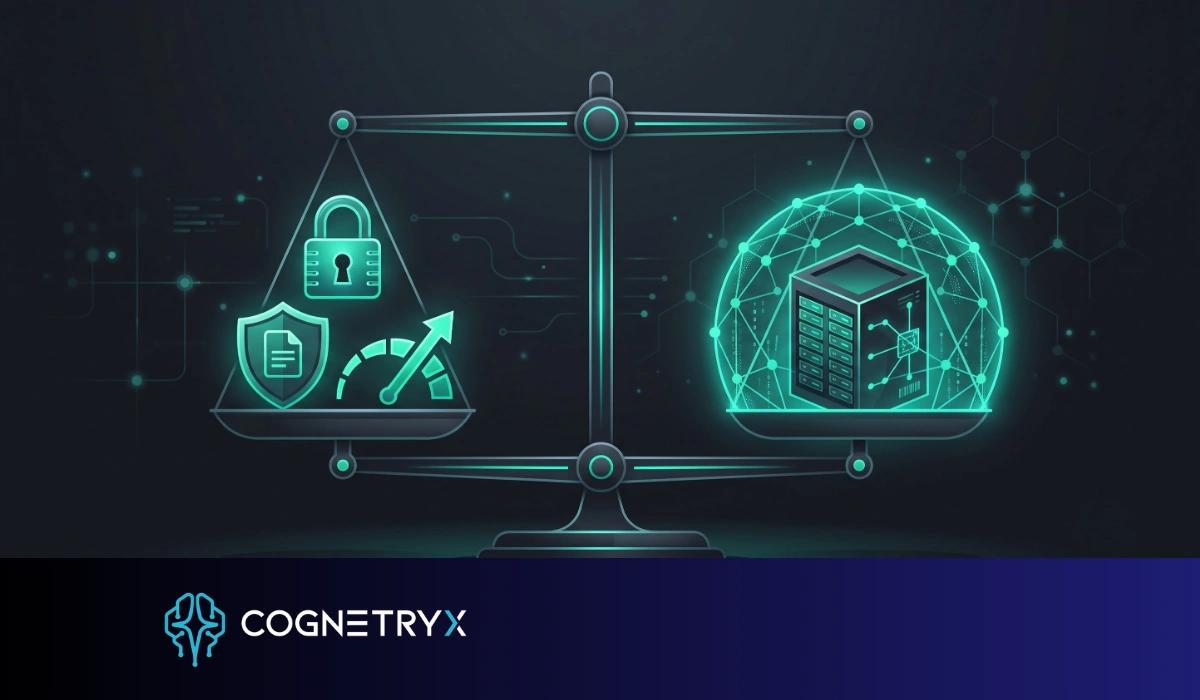
Most enterprise AI decisions come down to three questions. Is it secure? Does it keep private data private? And what will it really cost? For a bank, a hospital, or a law firm, the answers separate a tool you can deploy from one that creates a problem you did not have. This is how cloud AI and private, owned AI compare on each, with the 2026 numbers behind them.
Cloud AI is fast to start and gives you the biggest models, but your data leaves your network, the security burden shifts to a vendor, and the bill climbs with use. Private AI runs inside your own environment, so the data stays put, the attack surface shrinks, and the cost is a flat number you can plan. For low-risk work, cloud is fine. For regulated data, owning it tends to win on all three.
| Dimension | Cloud AI | Private, owned AI |
|---|---|---|
| Security | Data leaves your network; you inherit the vendor's breach exposure and third-party risk | Data stays inside your perimeter; smaller attack surface, your own controls and logging |
| Privacy | Prompts and documents may be processed or retained externally; residency and subprocessors depend on terms | Nothing leaves the environment you control; residency is answered by architecture |
| Cost | Per-user or per-token pricing that climbs with adoption and is hard to forecast | A fixed cost you own, flat no matter how much your team uses it |
How do cloud and private AI compare on security?
Cloud AI moves the security question outside your walls. Every prompt and document sent to an external service becomes someone else's system to protect, and their breach becomes your exposure. The 2026 numbers make the stakes concrete:
- The average US data breach now costs 10.22 million dollars, an all-time high, and healthcare leads every industry at 7.42 million (IBM, most recent Cost of a Data Breach report).
- One in five breaches studied involved shadow AI, unsanctioned tools employees used without oversight, and each added as much as 670,000 dollars to the bill (IBM).
- Verizon's 2026 Data Breach Investigations Report found shadow-AI detections rose fourfold in a year, now a leading insider-threat pattern.
Private AI narrows the problem. When the model runs inside your network, the data never crosses a boundary you do not control, the attack surface shrinks, and your existing access controls, logging, and monitoring extend to the AI the same way they cover any other system. It also removes the incentive behind most shadow AI: people reach for outside tools when the sanctioned option is slower, so a fast internal one closes the gap. See the finance-sector view in AI data leakage in financial services.
How do cloud and private AI compare on privacy?
Privacy is the concern buyers name first, and cloud AI is where it breaks. Sending regulated records to an external model means the data leaves the network you are responsible for protecting.
- 71% of enterprises name data privacy and security as their top barrier to using generative AI, ahead of accuracy at 58% and cost at 44% (2026 industry survey).
- Only 38% report high confidence in their cloud security posture (NTT DATA, 2026).
- Nearly 60% of AI leaders cite cross-border data restrictions as a major obstacle, and more than 95% say private or sovereign AI matters, though only about 29% are acting on it (NTT DATA, 2026).
Private AI answers the privacy question by architecture rather than by promise. If the model, the data, and the search layer all live inside your environment, there is no external processing to disclose, no residency question to litigate, and no vendor subprocessor to vet. That is the difference between a policy that says your data is safe and a design where it never leaves. We walk through the underlying question in is it safe to put company data in AI.
How do cloud and private AI compare on cost?
Cloud AI looks cheap in a pilot and gets expensive at scale. The pricing that makes it easy to start is the same pricing that makes the bill hard to predict.
- 73% of enterprises reported that their AI costs exceeded original projections, and token consumption has grown roughly 13 times since January 2025 (2026 industry analysis).
- Per-token prices span a 4,500x range between the cheapest models and frontier ones, and a single agentic workflow can burn 10 to 50 times the tokens of a simple query.
- Per-user subscriptions run from about 3 to over 100 dollars per user per month, and climb as adoption grows.
Private AI trades a per-use meter for a fixed cost. On-premises hardware is a known capital number, and running it is a steady line item rather than a bill that rises every time the tool proves useful. For a team using AI heavily, a flat cost you own is usually cheaper over a few years, and always easier to forecast. The full math is in token costs explained and the cost savings breakdown, and the ownership case is in own or rent your AI model.
A framework for deciding: questions to ask any AI vendor
Run any enterprise AI option, cloud or private, through these questions. The answers tell you where it really stands on security, privacy, and cost.
- Where does the model run, and does any prompt, document, or log leave our network?
- Is our data used to train or improve the vendor's model, and can we turn that off in writing?
- Where does the data physically reside, and who are the subprocessors that can touch it?
- Does the system use our single sign-on and access rules, so people see only what they are cleared to see?
- Does every answer cite its source, so a reviewer can verify it?
- What is the total cost over three years, and does that number stay flat as usage grows, or climb?
If a vendor cannot answer the first three plainly, the data is not as contained as the pitch suggests.
Where this leaves regulated teams
On low-risk work, cloud AI is a reasonable default. On regulated data, the three lenses tend to point the same way. Keeping the model inside your own environment shrinks the breach exposure, answers the privacy question by design, and replaces a climbing meter with a cost you can plan.
That is the architecture Cognetryx builds: a private AI platform that runs inside your network, grounded in your own documents, with every query logged and every answer traceable to its source. For the wider picture on where enterprise AI stands right now, see our read on the state of enterprise AI in 2026.
Sources: IBM, Cost of a Data Breach Report (most recent edition, US and healthcare averages, shadow-AI findings); Verizon, 2026 Data Breach Investigations Report; NTT DATA, 2026 Global AI Report (cloud-confidence and cross-border data findings); 2026 industry surveys on generative AI barriers and enterprise AI cost overruns. Figures are current as of July 2026.
See private AI answer your security and privacy questions
Book a short demo and watch a private model work on real questions inside your network, with the data, the logs, and the cost all staying on your side.
Request a Demo