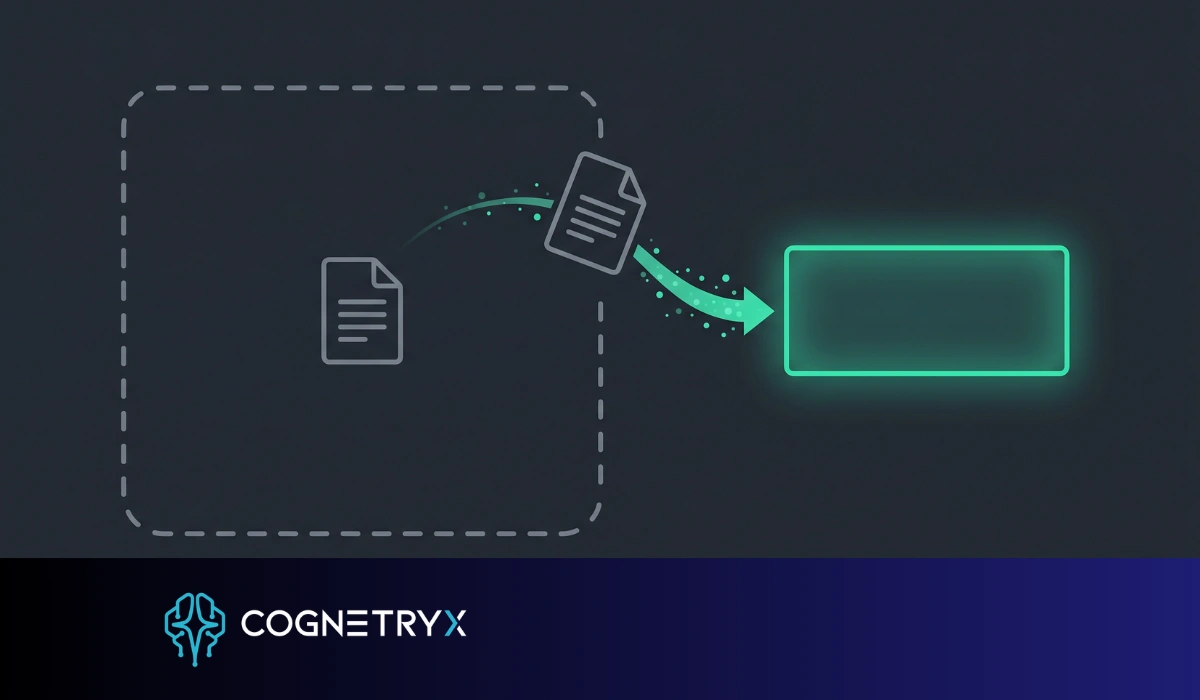
For sensitive or regulated company data, putting it into a public AI tool is usually not safe. The moment you paste text into a public chatbot, it leaves your network and ends up on the provider's servers under their rules, where it can be stored, logged, reviewed by staff, and on consumer tiers often used to train future models. Enterprise plans reduce this with a contract promise not to train on your input, but the data still leaves your environment; the cleaner fix is a sanctioned private AI that runs inside your own network so prompts, files, and answers never cross to an outside service.
Someone on your team has a deadline. They paste a contract, a customer list, or a spreadsheet of account data into a public AI chatbot to summarize it or clean it up. It saves them twenty minutes. The question is what it costs you, and the honest answer is that it depends entirely on the tool and the data. For sensitive or regulated data in a public tool, the answer is usually no, it isn't safe.
What actually happens to what you paste
The moment that text leaves the browser, it leaves your network. It travels to the provider's servers and becomes subject to their rules, not yours. Depending on the product and its settings, the content can be stored, logged, reviewed by staff for safety and quality, and in consumer tiers often used to help train future versions of the model. It usually sits in chat history until someone deletes it. And it's now exposed to the provider's own security, any breach they suffer, and any legal process that reaches them. In plain terms, you've disclosed it to a third party, whether or not anyone meant to.
Why regulated work makes it worse
For a bank, a hospital, or a law firm, the data people most want AI to help with is usually the data the rules exist to protect: customer financial records, patient information, privileged documents. That's exactly what tends to get pasted. The 2026 Cloud Security Alliance survey of financial firms put a number on it: 61 percent named sensitive data leakage their top AI risk, ahead of any hacking technique, and most of that leakage happens through ordinary use like this. The report even quotes a security chief who caught staff pasting customer records into a public chatbot to reconcile them. They got lucky and caught it. Most don't have the monitoring to.
The free-tier trap
Not all tiers are equal, and the difference matters. Consumer and free tools frequently train on what you type unless you dig into settings and turn it off. Enterprise plans usually promise in the contract that they won't, which is better, but two things stay true. You're trusting a contract and the vendor's controls rather than anything physical, and a signed agreement doesn't move where the data sits. It's still leaving your environment and landing in theirs.
How to use AI without the risk
The fix isn't a ban. Bans mostly push the behavior underground, and people keep pasting on their phones. What works is giving people a sanctioned tool good enough that they don't need the public one, and choosing one where the data doesn't leave in the first place. The cleanest version of that is private AI that runs inside your own environment, so prompts, files, and answers never cross to an outside service. Same convenience for the person on deadline, without the disclosure.
This is the short version of a bigger pattern. For the full read on how sensitive data leaks through everyday AI use, and the survey data behind it, see How Sensitive Financial Data Actually Leaks Through AI. For how a private setup handles this in practice, see Private AI for Banking & Finance.
Give people an AI they can paste into safely
Book a short demo and watch a private model do the same work on your own documents, with no data leaving your network.
Request a Demo