For most of the last two years, running AI inside your own walls was the conservative position. It was what you did if your compliance team was nervous, or if your board had been burned before. The default was a cloud service, and private AI was the exception you had to justify.
That flipped in 2026.
Four things changed this year. The market started paying for sovereignty, with Palantir posting $1.9 billion in a quarter at 93% growth and naming AI sovereignty as the reason. Breach data got worse, with IBM finding 92% of organizations attacked through their AI had no access controls on it. Cloud AI pricing became impossible to forecast. And regulators kept asking for records that only an institution holding its own can produce. None of those is a privacy argument. All of them point the same direction.
What just happened in the market?
Palantir reported second-quarter revenue of $1.9 billion, up 93% from a year earlier, and raised full-year guidance to roughly $8.15 billion. US commercial revenue alone grew 149%. Their CEO told investors that "demand for AI sovereignty has now been unleashed."
They are a vendor and that is a sales line. But the number underneath it is real money from real buyers, and the company attributes the growth to enterprises moving away from per-token cloud services toward deployments they control. When a market pays that much for something, the argument has moved past theory.
Deloitte reached a similar place from a different direction, naming sovereign AI one of the three themes shaping 2026. Research from NTT DATA found 95% of leaders say private and sovereign AI matters to them, while only 29% have done anything concrete about it. That gap is the story of the next two years.
Why did the security math change?
Because attackers found the AI systems, and almost nobody had locked them. IBM published its 2026 breach report on July 29, covering 602 breached organizations across 17 industries. The average breach now costs $4.99 million, up 12% in a year, and the AI-specific findings are worse than the headline number suggests.
Among organizations attacked through their AI systems, 92% had no access controls on those systems at all. Only about 4 in 10 organizations restrict access to their AI in any way. Shadow AI incidents doubled.
Read that next to how cloud AI works. Your documents travel to someone else's servers to get an answer. That vendor's security posture becomes part of yours, and their breach becomes your incident report. We wrote up the full IBM findings here, including the honest caveat that self-hosting does not create access control by itself. What it does is put the controls where your team can enforce and inspect them.
Why can't you budget for cloud AI anymore?
Because the bill is three moving numbers multiplied together, and you control none of them. The price per token is falling fast, the volume of tokens is rising faster, and the amount any single task consumes changes between runs. A budget needs one number. Metered AI gives you a range that keeps moving.
Goldman Sachs expects token consumption to rise 24 times between 2026 and 2030. At the same time, the price per token is falling 60 to 70% a year. And the number of tokens any single task uses changes from one run to the next, because the model does not produce the same answer twice.
Usage policies do not fix the third one. Ask the identical question on Tuesday and Thursday and you can get two different bills. Even the vendors selling AI features say they cannot price their own products reliably. We laid out the full arithmetic in our cost forecasting piece.
A private deployment is a fixed number. Hardware, software, and the people who run it. Usage triples and the number stays where it is. At small volume that is worse economics than metered cloud, and any honest comparison says so. At institutional volume it is both cheaper and, more importantly, a figure you can put in a board packet and defend.
Where are the rules pointing?
At control, consistently, no matter which regulator you look at. Nobody is asking whether your AI is clever. They are asking who can reach your data, who reviewed the decision, and whether you can produce the record a year later. Those are architecture questions wearing compliance language.
- Banking. The revised model risk guidance, SR 26-2, took effect in April and excludes generative and agentic AI from its scope by name. Whatever governs your AI deployment right now, your institution wrote it, and you will be asked to show your work.
- State law. Colorado's replacement AI statute takes effect January 1, 2027 and dropped the exemptions the old law gave some federally regulated firms. It requires an explanation within 30 days when an automated decision goes against a consumer.
- Europe. The high-risk deadlines moved to December 2027, but nothing was withdrawn. The transparency rules started on schedule on August 2, and breaking them now carries fines of up to 15 million euros or 3% of global turnover.
- Everywhere. Examiners want an inventory of AI in use, a written policy, evidence a human reviewed consequential decisions, and an audit trail somebody outside your company can verify.
You can produce a configuration file, an access log, and a test result. You cannot produce a vendor's internal retention schedule on demand, and you cannot promise an examiner what a third party will still be holding next year.
What is private AI, exactly?
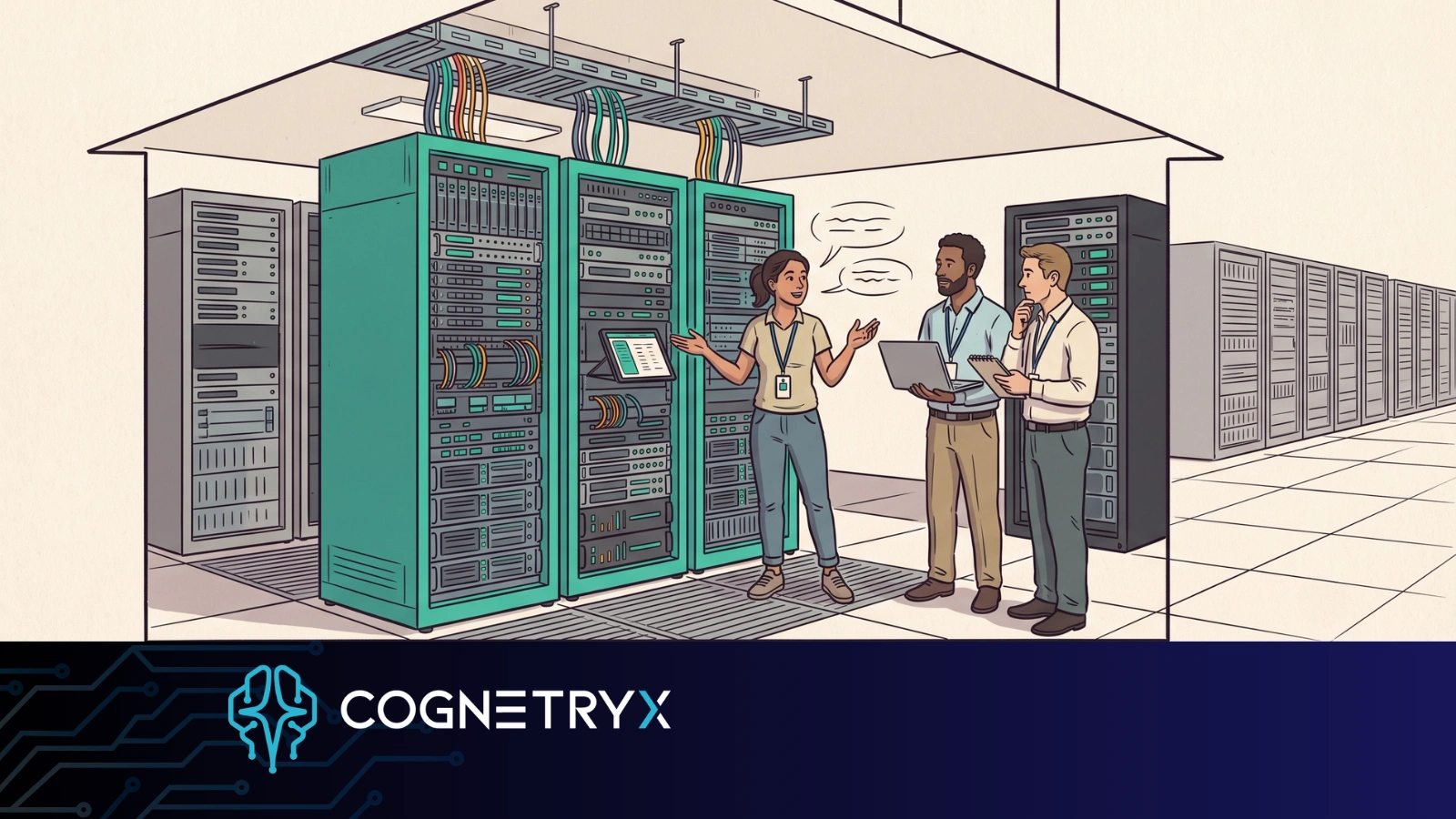
The model runs on hardware you control, inside your network, reading your own documents. Your questions and your files never leave the building to be answered. Everything else follows from that one fact, because the search layer, the permissions, and the audit logs all live wherever the model runs.
That is the whole definition. People call it on-premises AI or sovereign AI, and for most purposes the terms describe the same arrangement. Our full guide covers the distinctions if you need them for a policy document.
What changed recently is that this stopped requiring a sacrifice. Open-weight models have closed much of the quality gap for the work regulated institutions actually do, which is answering questions from their own documents. For that job, a smaller model with good search over your own files usually beats a larger model that cannot see your files at all.
Where Cognetryx fits
We build the thing described above. The model, the search index, and the audit logs all run inside your network, on hardware you control.
In practice that means:
- Your documents are never sent to an outside AI service, because there is nothing to send them to.
- Search respects the permissions you already set, so an employee only gets answers from files they were already allowed to open.
- Every answer cites the source it came from, so a reviewer can check it.
- The log of who asked what stays on your systems, under your retention schedule.
- The cost is a fixed subscription rather than a meter that climbs with adoption.
We are not going to tell you every organization needs this. If your AI work is low volume and touches nothing sensitive, a cloud service is fine and cheaper. The case for private AI gets strong exactly where the stakes do: regulated records, client confidences, examination exposure, and volume that makes a meter painful.
If that describes your institution, the four forces above are not going to reverse. The market is paying for control, breaches keep finding AI systems nobody locked, metered pricing keeps getting harder to forecast, and every regulator keeps asking for records you can produce yourself.
The question is no longer whether to bring AI inside. It is how long you want to keep answering for a system you do not hold.
See what private AI looks like on your own data
A short assessment maps where AI is already in use at your institution, what each tool can reach, and what running it inside your own environment would take. Nothing leaves your network to find out.
Book a Free AI Strategy Assessment