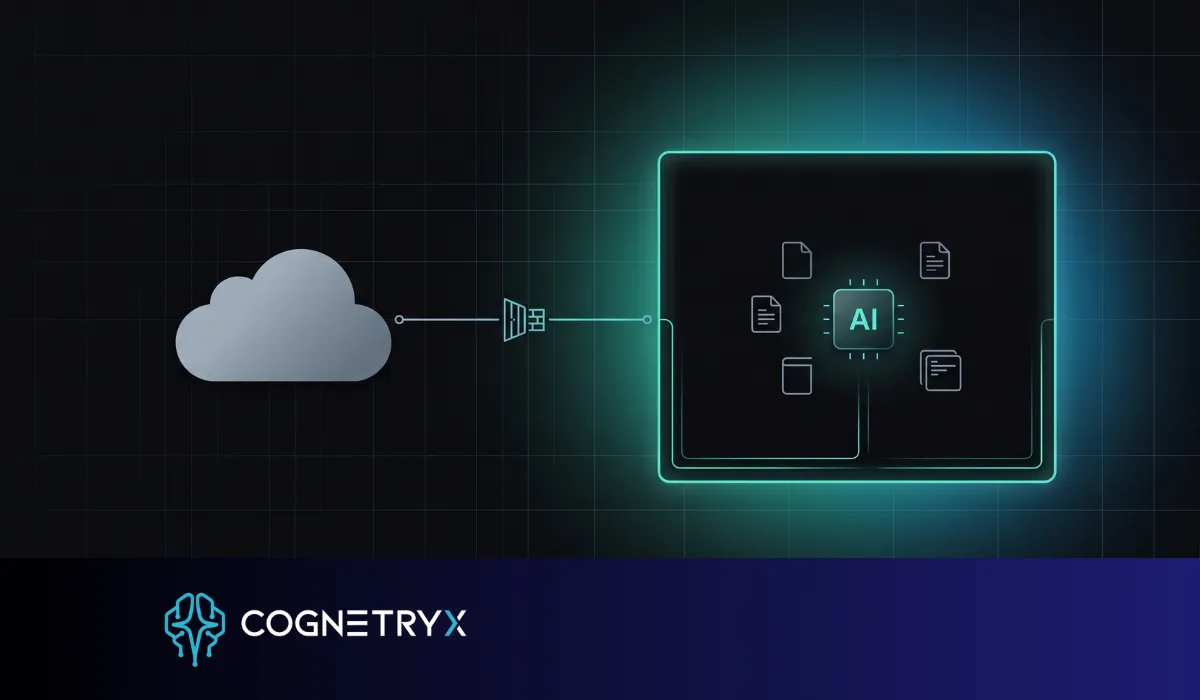
Ask a room of executives whether their AI is governed and most will say yes, or that they are working on it. Ask the next question, the one that decides real exposure, and the room gets quieter. If a regulator asked you to prove what your AI did last Tuesday, and to show you could have stopped it from doing the wrong thing, could you?
That is what governance is really asking. Not whether you have a policy document. Whether you can enforce the policy, prove what happened, and show the proof to someone outside your company. And the answer depends heavily on where the AI runs.
What does AI governance actually mean?
Strip away the jargon and AI governance is three plain abilities. You can say what the AI is allowed to do. You can prove what it did. You can stop what it should not do. Everything else is detail on top of those three.
The public frameworks describe the same shape in different words. The NIST AI Risk Management Framework is built around four functions, Govern, Map, Measure, and Manage, with Govern as the one that runs through all the others: the policies, the accountability, the record-keeping. ISO/IEC 42001 sets up an AI management system, the way older standards set up systems for quality or security. And the EU AI Act ties hard obligations to how risky a given use is, with rules for general-purpose models already in force and rules for high-risk systems arriving in 2026. Three different documents, one underlying idea: control you can show.
Governance is not the document. It is whether the document is enforceable. A policy that says "the AI will only use data the user is allowed to see" means nothing if the system cannot actually enforce it and log it. The question is always: can you prove it, and can you stop it.
Why does it matter where the AI runs?
Here is the gap. Governance is only as strong as your ability to enforce it, and your ability to enforce it changes with the deployment model. Two companies can write the exact same AI policy. The one whose data leaves the building to be processed can enforce far less of it than the one whose data never moves.
When your documents and your AI run inside your own environment, you decide who sees what, you keep every log, and you can produce a full record on your own. When the work happens in someone else's service, a real part of your governance lives in that vendor's settings and contract terms. You can still govern well there. You just have less of it in your own hands, and more of it resting on configuration you do not fully control.
A short way to decide
You do not need a maturity model to make this call. Five questions get most organizations to the right answer.
- How sensitive is the data the AI will touch? Patient records, client files, and regulated material raise the bar. Public marketing copy does not.
- What do your regulators expect? Some rules care a great deal about where data is processed and who can reach it. Some do not.
- How fully do you need to audit it? If you will have to reconstruct what the AI did, and defend it, you need the logs in your own hands.
- Who is allowed to see what? If permissions inside your organization are complex, the AI has to honor them at the moment of the query, not after.
- What happens to your data after the AI uses it? Where it is stored, how long it is kept, and whether it trains anything are governance questions, not footnotes.
Answer those honestly and the deployment model usually picks itself. The more your answers point to sensitive data, strict regulators, and deep audit needs, the more governance you want to hold directly, which means keeping the data and the model close.
Cloud, locally hosted, on-premises: the honest tradeoffs
This is a spectrum, not two boxes. It helps to see all three points on it without a strawman.
Public cloud AI is the fastest way to get started. The tradeoff is that your data travels to a service you do not run, and your governance leans on that provider's terms, region settings, and controls. For lower-sensitivity work, that can be a fine trade. For regulated material, the questions above get harder to answer.
Locally hosted, or private, deployment runs the system inside your own boundary, whether that is your own cloud tenant, your virtual private cloud, or your data center. Your data stays where you already govern it. You hold the logs and the access rules. For most regulated organizations, this is the practical sweet spot: strong control without standing up a full data center of your own.
Fully on-premises puts everything on infrastructure you run and control. It gives you the most direct control and the cleanest answer to "where is our data," which is why it is the default we reach for with the most sensitive environments. It also asks the most of your team and budget up front.
Cost shape runs opposite to what a pilot suggests. Public cloud AI is billed per use, so the price climbs with every query, and it can come with rate or usage caps that throttle a heavy workflow. The more your team adopts it, the larger the bill, so scaling a success turns into a budget problem. That is a strange way to be penalized for growth. A locally hosted or on-premises deployment is mostly a fixed infrastructure cost: more up front, then steady no matter how much your team uses it. For an organization putting AI to work across many people and daily tasks, that predictability, and the absence of a per-query meter, can matter as much as the governance.
| Public cloud | Locally hosted (private) | Fully on-premises | |
|---|---|---|---|
| Speed to start | Fastest | Moderate | Slowest |
| Where your data goes | To the provider's service | Stays in your own boundary | Stays on hardware you run |
| Who holds the logs and access rules | Shared with the vendor | You | You |
| Cost shape | Per query, climbs with use | Mostly fixed | Mostly fixed, highest up front |
| Best fit | Lower-sensitivity work | Most regulated organizations | The most sensitive environments |
The constant across all three is not the rack location. It is data control and an audit trail you can produce yourself. A locally hosted private deployment and a full on-premises install can both clear the governance bar. A public service can too, with the right terms, but more of the proof lives outside your walls. Choose the point on the spectrum that matches how much of the proof you need to hold.
Where Cognetryx fits
Cognetryx runs inside your environment. On the most sensitive deployments that means fully on-premises, and that is our default starting point. For teams that are cloud-first or have no data center of their own, it can run locally hosted in your own cloud tenant. Either way, your data and the model stay inside your boundary, and the governance controls come with the platform rather than bolted on after.
Concretely, that means three things a leader can check. Permissions are enforced inside the query, so the model only ever works with material the user is cleared to see. Every answer is tied to the source passage that supports it, so claims can be traced back to a real page. And every interaction, including the times the system declines to answer, is logged and can be exported for an auditor. Measurable, auditable, and governable are properties of how the platform is built, not features you have to assemble. The how it works page walks through the mechanics, and the piece on answers that hold up under scrutiny goes deeper on the citation and refusal trail.
Because the platform runs inside your environment, the cost behaves differently too. There are no per-token fees and no usage caps, so your team can work across daily tasks without watching a meter or rationing queries. Query volume changes your results, not your invoice.
Governance is not a setting you switch on at the end. It is decided the moment you choose where the AI runs, because that choice decides how much of your own policy you can actually enforce.
One honest note, because it matters in regulated work. No platform makes you compliant on its own. Frameworks like NIST and ISO, and laws like the EU AI Act, put the responsibility on your organization to run the controls and keep the records. What a private, locally hosted deployment gives you is the ability to hold those controls and produce those records yourself, rather than asking a third party for them when the examiner is already in the room. For a sense of how this plays out where the rules are strictest, the piece on controlled unclassified information and AI is a useful companion.
Map Your Governance to a Deployment That Fits
Bring your data sensitivity, your regulators, and your audit needs. In a free AI Strategy Assessment with Keith Kennedy, CISSP, we will map where on the cloud-to-on-premises spectrum your AI should live, and what governing it would actually take.
Book a Free AI Strategy Assessment →