Most enterprise AI looks great in the demo and stalls in the review. The pilot impresses someone in a conference room, and then security, legal, and finance start asking the questions that actually decide things. Where does our data go? Who controls the model? Can we prove what it said six months from now? And what happens to the bill when a hundred-person pilot turns into ten thousand people using it every day?
For a bank, a hospital, a law firm, or an agency, those questions aren't hurdles to clear on the way to a yes. They are the job. AI that reads internal policies, case files, clinical notes, or underwriting decisions has to behave like every other governed system in the building: known access rules, a record of what it did, a boundary it stays inside, and a cost someone can put in next year's budget. An open-weight model, deployed the right way, is one of the few approaches that keeps all of that in-house. It's the approach we built Cognetryx around, so it's worth explaining plainly — including where it doesn't fit.
What "open-weight" actually means
The term gets used loosely, so let's be exact. An open-weight model is one whose trained parameters — the weights — you can download and run on infrastructure you control. The weights are the model's learned behavior. Running them inside your own environment gets you a lot more than an API key does.
You decide where inference happens and how prompts and retrieved documents are handled. Access rules, tuning, and the way the model fits the work your people actually do become your decisions instead of a vendor's defaults. And you can hold the system to your own security standards rather than taking someone's word for theirs.
None of that makes every open-weight model ready for real work. Some are too large to run economically on the hardware you have. Some need tuning before they're any good at your specialized tasks. Some ship with license terms your counsel will want to read line by line. Open weights are not automatically the better choice. But they change who is in control, and for CIOs, CISOs, and compliance teams, that is what matters.
Why regulated buyers are taking this seriously
The first wave of enterprise AI ran on speed. Teams wanted to try things, and cloud-hosted models made trying things easy. The second wave is more careful, because everyone has now lived through the security reviews, the data-handling questions, and the invoice that didn't match the forecast.
The numbers track the shift. In a 2025 survey of more than 700 technology leaders, McKinsey found that more than half of organizations already use open-source AI somewhere in their stack, and roughly three-quarters plan to use more. Buyers stopped asking only whether a model is smart enough and started asking whether the whole system fits the way they're allowed to operate.
That caution is earned. MIT's 2025 study on the GenAI Divide found that 95% of enterprise generative AI pilots produced no measurable impact on the bottom line — and the cause had less to do with which model teams picked than with everything around it. Permissions, retrieval, deployment, ownership: that is what decides whether a pilot becomes something people rely on.
What the right setup looks like depends on the shop. A bank keeps inference inside its own network so customer data never crosses an approved boundary. A hospital puts the same identity controls and audit rules on AI that already govern every system touching patient records. Legal and government teams keep documents confidential while holding a clear record of what the system produced and why.
The model is the easy part; the architecture is the rest
Security teams rarely push back on AI because they dislike it. They push back when a deployment creates gaps they can't close — external inference, vague retention terms, subcontractors nobody can fully map, thin audit trails. Each of those turns a quick review into a slow one.
Open weights remove a lot of that, but only when the model is deployed with the rest of the controls around it. On-premises alone isn't the answer. The answer also includes single sign-on, role-based access, logging, document-level permissions, network isolation, and real governance over which data sources the system can reach at all.
This is why the architecture matters more than the model's name. In a regulated enterprise, the model is one component of a governed application. If the system pulls an internal document, drafts an answer, and ties each claim back to approved source content, a reviewer can judge whether the output is grounded. If access follows the user's identity, the AI won't read someone a file they were never allowed to open. If prompts, sources, and responses are logged, audit has something concrete to inspect.
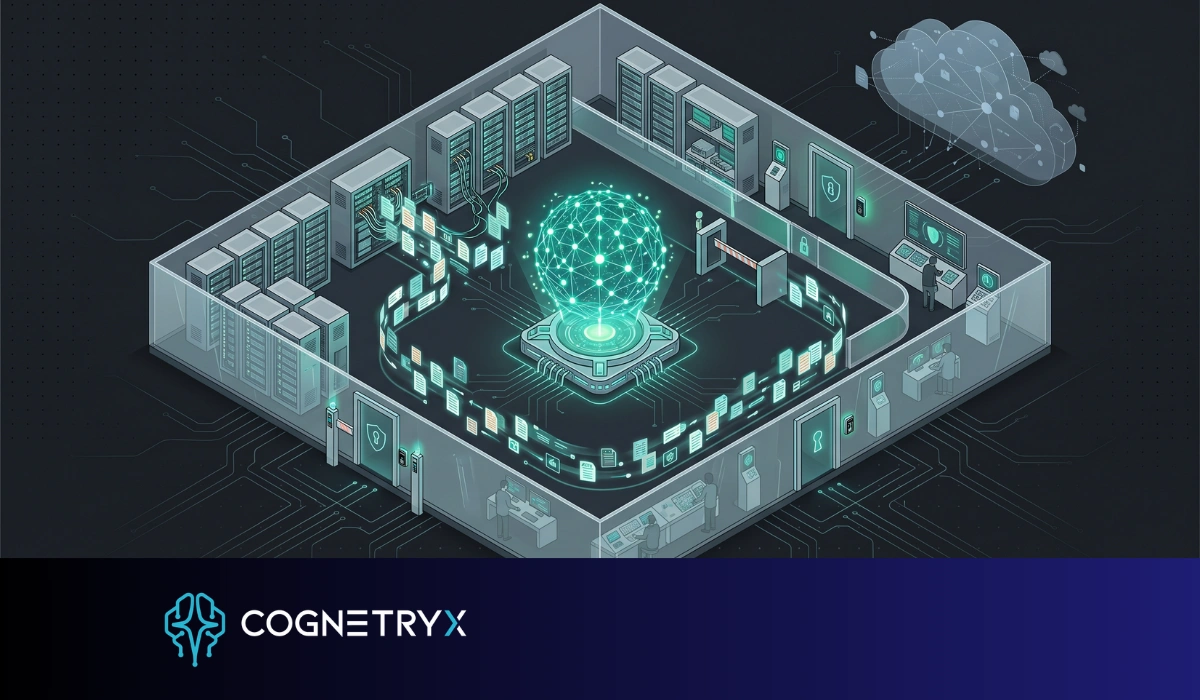
That is the shape Cognetryx is built in: an open-weight model running inside the customer's environment, retrieval that respects each user's existing permissions, a citation on every answer, and a log of what the system saw and returned. The model itself can be swapped or upgraded; the controls around it stay put.
And no deployment makes risk vanish. Hallucinations still need guardrails. Sensitive data still needs classification and handling rules. Tuning and prompt design can still introduce new ways to fail. Owning the environment doesn't erase those problems — it puts them somewhere you can see and manage them.
What ownership does to cost and roadmap
When enterprises talk about owning the model, they usually mean more than the intellectual property. They mean independence: choosing your own hardware, tuning for your own cases, deciding when to upgrade, and not tying every AI workflow to one vendor's service boundary. A pilot can live with some vendor dependence and a few manual workarounds. A core internal system usually can't.
The cost math points the same way. Consumption pricing is fine in early testing and hard to forecast once usage spreads. Zylo's 2026 SaaS Management Index found that 78% of IT leaders had already been hit with an unexpected bill from consumption or AI pricing, and 61% had to cut projects because of unplanned software costs. Run the model on infrastructure you own and the cost basis shifts toward planned capacity — a number finance can actually defend.
Ownership shapes data strategy too. Companies with deep proprietary knowledge often find the base model is the smallest part of the value. What matters more is how it meets their own material: the private documents, the workflow logic, the permission structures, the in-house shorthand no general model has ever seen. Keep all of that inside a controlled environment and you have room to improve accuracy without shipping sensitive context out the door.
There is a bill for it, of course — ownership means responsibility. Now you're the one planning infrastructure, running model operations, applying patches, watching performance, and managing capacity. For organizations with a platform team, that is routine. For those without one, it is exactly where a managed deployment earns its keep, and it is why Cognetryx runs the operations side — so the customer's team can stay focused on the work instead of the GPUs.
Where open-weight models earn their place
The best fits share three traits: the data is sensitive, the work repeats, and the output has to be explainable.
Internal knowledge search is the obvious one. People need answers out of policies, contracts, procedures, manuals, or case records, and they need to see the source behind each answer. Document analysis is another — teams pulling apart, comparing, and questioning large sets of internal files without sending them anywhere. Reporting and decision support work well too, as long as a person reviews the output and can check it against the source.
These are unglamorous jobs. None of them depend on AI sounding brilliant in a demo; they depend on it being useful while the governance holds. That is usually why regulated teams reach for a private deployment in the first place, and it is the work Cognetryx is pointed at: fewer hours lost to searching and assembling, without giving up control of the material.
What to check before you commit
Model quality matters, but it's a weak place to start an evaluation. The operating questions decide whether the thing holds up in your environment. A few worth asking, roughly in order:
- Data boundaries. Can the system run entirely inside the network or private environment your policy requires, with nothing leaving by default?
- Access control. Does it work with your identity provider, your user roles, and your document entitlements — or does it flatten all of that the moment someone asks a question in plain English?
- Auditability. Can you reconstruct what the system saw, what it returned, and which sources it used — months later, for someone who wasn't in the room?
- Performance and footprint. Latency, throughput, and hardware cost all decide viability. A model can be accurate and still too expensive to serve at the concurrency your users need. Often a smaller model with strong retrieval beats a big general-purpose one.
- Licensing. Open weights don't always mean unrestricted commercial use. Have counsel and procurement read the terms, especially for external-facing or regulated decision workflows.
- Your own documents. Test on real files, not generic benchmarks. Internal acronyms, scanned pages, old templates, and inconsistent metadata are where polished demos start to wobble. Better to find that out in week one.
The practical case
For a lot of enterprises the decision comes down to something plain. They want a capable model without handing over control of sensitive data, budget predictability, or their own governance standards. They want AI to behave like enterprise software — clear boundaries, and a clear owner when something goes wrong.
That doesn't mean everything belongs on-premises. Most organizations will run a mix: private open-weight systems for the most sensitive work, hosted services for the rest. The right split depends on how sensitive the data is, what your team can run, and how central AI is becoming to the actual work.
The direction is getting clearer, though. As AI moves from experiment to daily operation, companies want systems they can inspect, govern, and budget for without bracing for surprises. That is the gap Cognetryx is built to fill: current model capability with the data, the retrieval, and the audit trail kept inside the customer's environment. If a model is going to work on information you'd never hand to a stranger, how it's deployed deserves as much scrutiny as the model itself.
For the full picture, start with the cornerstone guide, Private AI for Regulated Industries. For how this gets deployed in practice, see On-Premises LLM Deployment, Explained, and for the build-side realities, Building Private AI: What IT Teams Actually Find.
See it on your own documents
The honest version of the pitch is short: a private, open-weight model answering real questions from your files, a citation on every claim, and nothing leaving your network. Bring your messiest documents to a short demo and judge it on those.
Request a Demo