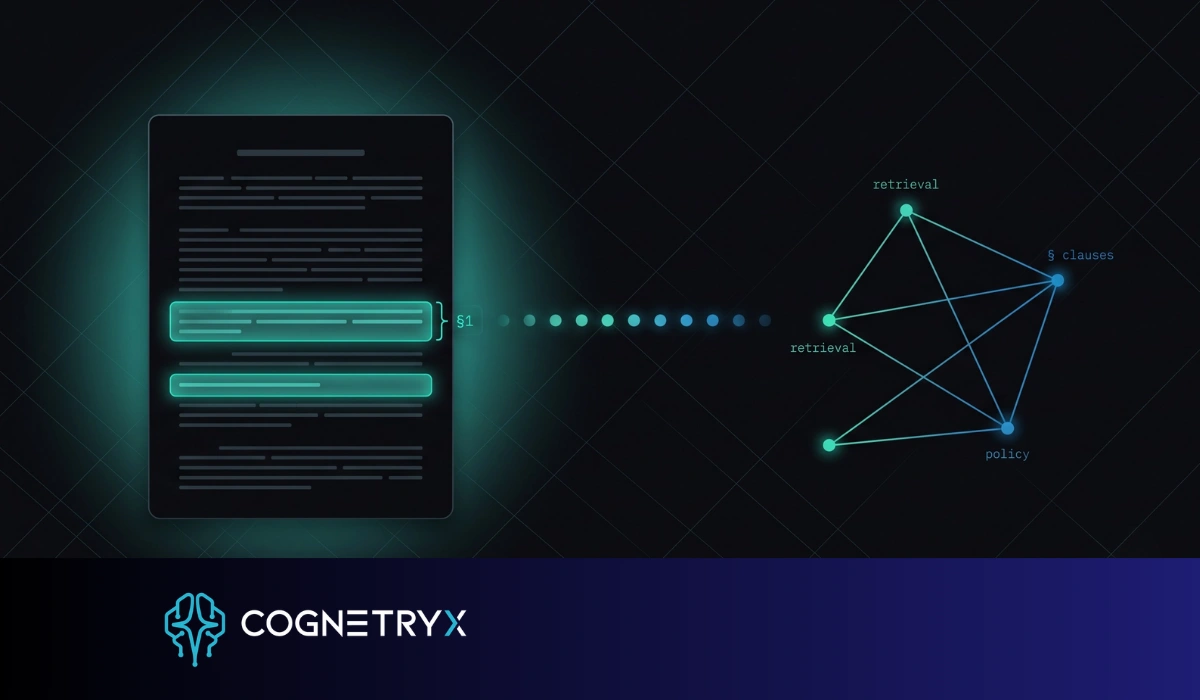
A legal document AI assistant for enterprises reviews contracts, policies, filings, and internal records using grounded retrieval over your own documents, returning plain-language answers tied to the exact source text so counsel can verify the sentence, section, and document behind each response. For regulated organizations, the deployment model matters more than the interface: a private assistant that runs inside your own environment keeps document access, model interaction, logs, and outputs under enterprise control, so security teams can apply SSO, role-based access, audit logging, and network segmentation. Evaluate it by testing data control, source citations, enterprise controls, and cost structure against your own redlines and dense materials, and keep human review in the operating model, since the tool supports attorney judgment rather than replacing it.
For regulated organizations, this isn't mainly about drafting faster. It's about reviewing large volumes of contracts, policies, filings, and internal records without sending sensitive material outside the network or creating a system nobody can defend in an audit. If the tool can't show where an answer came from, log who used it, and respect access controls, it's not ready for serious legal work.
What should a legal document AI assistant actually do?
A useful system starts with grounded retrieval over your own documents. Users ask plain-language questions across contracts, amendments, case files, policies, and governance materials, and get answers tied to the exact source text. The citation layer isn't optional. Legal teams don't need eloquent guesses. They need to verify the sentence, section, and document behind the response.
Practical document analysis matters too: identifying unusual clauses, comparing versions, flagging missing terms, summarizing long agreements, extracting key obligations and dates. Speed only counts if the output is reviewable. The tool should reduce the time spent hunting for language, not ask counsel to trust unsupported conclusions.
There's another requirement that gets overlooked in product demos. Legal work doesn't happen on a clean set of PDFs in one folder. Documents live in matter systems, shared drives, email archives, contract platforms, and internal knowledge bases. If the assistant can't connect to the systems your team already uses, adoption stalls early.
Why deployment model matters more than the interface
A polished chat window is the least interesting part of the stack. The harder questions are where the model runs, where documents live during processing, and what leaves the environment.
When sensitive legal material is sent to an external service, the risk review gets complicated fast. Data handling, retention policies, cross-border exposure, vendor controls, privilege and confidentiality considerations. Some organizations can accept those trade-offs for low-risk use cases. Many can't.
A private legal document AI assistant sidesteps most of that. Running the platform inside your own environment keeps document access, model interaction, logs, and outputs under enterprise control. Governance becomes more realistic. Security teams can apply SSO, role-based access, audit logging, network segmentation, and source permissions within the same operational model they already manage.
For firms handling privileged or regulated material, private deployment changes the conversation. Whether AI is inherently risky stops being the operative question. It becomes whether the system is governed like any other critical internal application.
Where do legal teams see value first?
The best early use cases tend to be unglamorous. They solve recurring work that consumes skilled time and depends on finding the right language quickly.
Contract review is the obvious starting point. A legal document AI assistant can pull termination rights, indemnity language, assignment clauses, notice requirements, and data handling terms across a large contract set, then compare incoming paper against internal standards and flag where provisions diverge. Counsel still decides what matters. The assistant shortens the path to the relevant text.
Policy and regulatory analysis fits well for similar reasons. In-house legal and compliance teams frequently need to map internal policy statements to regulatory obligations, or compare revisions over time. The work is tedious and the cost of a missed change is high. A system that retrieves, summarizes, and cites the governing text can improve consistency without pretending to replace legal judgment.
Internal investigations and dispute support are a different kind of use case. When facts are scattered across memos, reports, contracts, and email-derived records, the time lost is usually in retrieval and chronology-building. AI can help assemble the picture faster, but only if outputs are traceable and access is tightly controlled. The governance requirements here are stricter than in contract review, and the consequences of a wrong answer are different.
The trade-offs are real
A legal document AI assistant is useful, but it doesn't substitute for legal reasoning, client judgment, or privilege analysis. Many deployments run into trouble because that expectation got set wrong at the start.
Models can summarize language incorrectly. They can miss nuance in cross-references, defined terms, exceptions, and jurisdiction-specific wording. They may flatten genuine ambiguity into a clean answer when the actual legal position is conditional. None of that goes away in a private deployment. Privacy and governance solve one class of problem. Accuracy and judgment still require process.
Human review has to be part of the operating model. The system should support attorneys and legal operations teams, not bypass them. Good implementations make verification easy. Weak ones hide uncertainty behind fluent text.
Document quality matters more than most vendors admit. If source documents are poorly scanned, inconsistently labeled, fragmented across repositories, or full of outdated versions, the assistant inherits those problems. Before teams expect high-quality answers, they need basic discipline around source systems, permissions, and records hygiene. That's not a vendor problem to solve. It's a precondition.
How to evaluate a legal document AI assistant
Most buyers don't need another feature matrix. A short set of questions exposes operational risk faster than a checklist does.
Data control. Where is the model running? Does any document content leave your environment? Who can access prompts, outputs, embeddings, logs, and model telemetry? Vague answers here are reason to stop.
Evidence. Can the assistant return source-cited answers against your own documents? Can users inspect the exact passage behind a summary or extraction? Without that, the review burden falls back on the user and most of the productivity value disappears.
Enterprise controls. Legal and compliance deployments need audit logs, role-based access, SSO, and connector support for existing repositories. They also need clear administrative boundaries. A pilot on a shared test set is one thing. Production deployment across legal, compliance, procurement, and risk is another, and the operational differences usually surface quickly.
Cost structure. Usage-based AI can create hesitation around broad adoption, especially when teams want to search large volumes of content repeatedly. Predictable economics tend to support operational use better than pricing models that make every query feel billable.
Your own documents. Not a generic benchmark. Not a sample contract from the vendor's library. Use redlines, amendments, policy exceptions, dense board materials, and the records your team actually struggles with. Performance becomes obvious against material that reflects real use.
Why regulated enterprises are building for ownership
Legal AI has moved past the pilot stage in most regulated organizations. That shifts what the buying conversation is actually about. The relevant question now is who can support a governed system that holds up under security review, internal audit, and the kind of scrutiny that comes when something needs to be explained.
When the deployment gives the enterprise control over where the system runs, how it’s configured, what models are used, and how records are retained, legal teams have a better shot at building something durable. When every material change depends on an external platform’s roadmap or policy decisions, risk and cost accumulate in ways that are harder to manage over time.
Private, on-premises architectures are drawing serious attention from legal, financial, healthcare, and government buyers for that reason: they fit the actual constraints these teams operate under. At Cognetryx, the argument is simple: if AI is going to work on sensitive internal documents, it should run inside the same control boundary as the rest of the organization’s critical systems.
A legal document AI assistant earns trust slowly. Usually by answering the boring questions correctly, citing its sources, respecting permissions, and saving experienced people time on work they never should have had to do manually. That’s enough to matter.
Legal AI That Stays Inside Your Network
Cognetryx deploys entirely inside your organization’s environment. Documents, queries, and outputs never leave. Grounded retrieval with source citations, audit logging, and access controls your compliance team can stand behind.
Request a Demo →