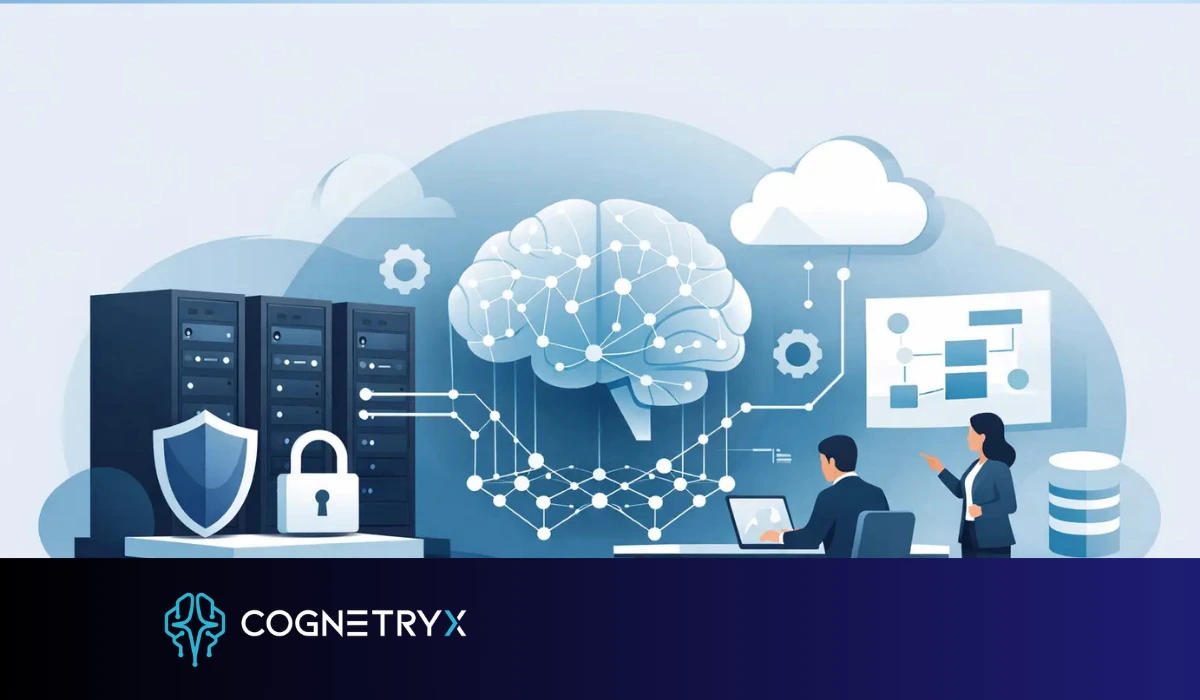
Most AI buying mistakes in regulated organizations start the same way. Someone judges the tool on how smart the model sounds. The model matters, but in a bank, a hospital, or a law firm it's a small slice of whether the thing is safe to run. What decides that is where it runs, what it can reach, who can use it, and what evidence it leaves behind. Here is how to pressure-test a private AI platform against the things security and compliance actually care about.
Start with the data boundary
The first question stops most evaluations cold: does your proprietary data ever leave your environment? If the model or the retrieval layer ships internal documents to an outside service, plenty of regulated buyers are finished right there, contractual assurances or not. A private platform should keep prompts, source content, and outputs inside your network boundary. No asterisks.
Can you trace the answer back
An answer you can't tie to a source is hard to trust and harder to defend. Ask whether every response comes with citations to the documents behind it, and whether the system logs who asked what, what data it touched, and how it built the result. In regulated work that trail isn't a nice extra. It's what makes the output usable when audit or legal comes asking.
Does it respect the permissions you already have
A good system doesn't flatten access just because someone asks in plain English. If a user can't open a document in the file system, the AI shouldn't read it back to them either. Look for access control by role, department, and data source, enforced down at the retrieval layer rather than bolted on at the prompt.
Will the cost survive success
Token-metered pricing looks fine in a pilot and turns into a budget fight once a few hundred people use it daily. Regulated work tends to mean broad internal access and high volume, which is exactly the usage per-query billing punishes. Ask whether the economics rest on owned infrastructure and a fixed platform cost, so scaling up is a planning decision instead of a surprise on the invoice.
Who controls the model
If your core workflows depend on one hosted model provider, you inherit their pricing changes, their limits, and their roadmap. Open-weight model support matters because it keeps that choice yours. Teams underrate it at the start and lean on it hard a year in.
The one-paragraph test
Here's the gut check that cuts through most of the marketing. Ask whether sensitive data ever leaves your control, whether outputs trace to source, whether permissions are preserved, whether costs stay predictable at scale, and whether your team can run the platform without leaning on a single outside vendor. If the answers are vague, the risk isn't.
For the full picture of what private AI for regulated industries involves, start with the cornerstone guide: Private AI for Regulated Industries. For the build-side realities, see Building Private AI: What IT Teams Actually Find.
Run the test on a real platform
Book a short demo and put these questions to a private model working on your own documents, with no data leaving your network.
Request a Demo