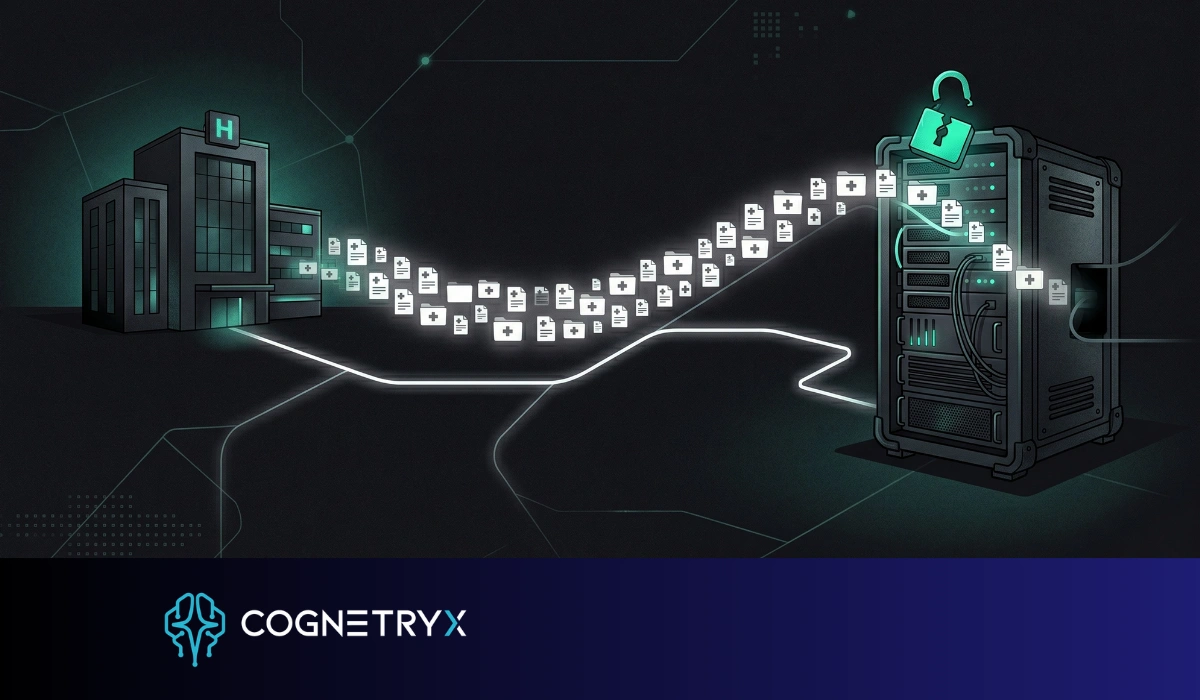
Most of the people whose health records were stolen had never heard of the company that lost them. It's called Healthcare Interactive, or HCIactive. It works behind the scenes for health plans and insurers, and it sells its services as AI-powered. In the summer of 2025, someone got into its network and copied files. By the time the count was final, the records of more than 3 million people were exposed. It was the fifth-largest healthcare breach reported that year.
None of those 3 million people picked HCIactive. Their employer or their health plan did. When you hand patient data to an outside company, you're trusting that company's security instead of your own.
What a vendor like this actually is
Under HIPAA, the federal health privacy law, a company like HCIactive is a business associate. That's any outside vendor that handles protected health information, the medical and personal data the law guards, on behalf of a hospital, a clinic, or a health plan. Billing companies are business associates. So are analytics firms, and now AI vendors. To do the work, they need a copy of the data. So the data leaves the building.
Where the break-in actually happened
The hack didn't happen at a hospital. It happened at the vendor. The files were sitting on HCIactive's network, and that's where they were copied, over a few days in July 2025, before anyone noticed. This is the common shape of a healthcare breach now. Year after year, a large share of breached records trace back to business associates rather than the hospitals and plans themselves. The data is most exposed at the point where it's been handed off to someone else's servers.
A signed contract doesn't stop a breach
Before a vendor can touch this data, it signs a business associate agreement, or BAA. That's the contract where the vendor promises to protect the information. A BAA is required, and it matters. It also doesn't add a single security control, and it doesn't move the data back inside your walls. When HCIactive was breached, the agreements it had signed meant nothing to the 3 million people whose records were already gone. A signature is a promise, not a wall. (For more on that gap, see the HIPAA problem your AI vendor's BAA doesn't solve.)
Regulators just made the point in dollars
In April 2026, the HHS Office for Civil Rights, the agency that enforces HIPAA, settled four ransomware cases at once. Together they covered more than 427,000 people and $1.165 million in penalties. One of the four was a business associate, a benefits administrator, that paid $225,000. In every case, the regulator's main finding was the same. The organization had never done a proper risk analysis. It hadn't taken an honest look at where its sensitive data lived and what could go wrong with it. The agency's position is blunt: that missing risk analysis is itself the violation. If you run a hospital or a health plan, that risk includes the vendors you send data to. It now includes your AI tools too.
How to stay out of the next headline
Look at what actually went wrong. The AI didn't make a bad call. The records were exposed because they were sitting on an outside company's servers, waiting to be useful. Smart software, wrong place. The way to keep out of that story is to keep the data from leaving in the first place. Private AI runs inside your own network. The model comes to your data. Your data doesn't go out to a vendor. So there's no outside copy of the records to steal, because there's no outside copy at all. You still need the basics: access controls, logging, and yes, a real risk analysis. What you drop is the handoff that put 3 million people into a breach notice they never signed up for.
Sources: HIPAA Journal, "Healthcare Interactive: More Than 3 Million Individuals Affected by July 2025 Security Incident" (final count 3,056,950; fifth-largest healthcare breach of 2025; files copied July 8–12, 2025). HHS Office for Civil Rights, "OCR Settles Four HIPAA Security Rule Ransomware Investigations" (April 2026) (four settlements, 427,000+ individuals, $1,165,000 in penalties, including a $225,000 business associate settlement; risk-analysis failure cited in each). HIPAA Journal, Healthcare Data Breach Statistics (business-associate share of breached records). This article is informational and not legal advice.
This one breach fits a pattern across the whole sector. For the original analysis of where healthcare data actually leaks, see What 710 Healthcare Data Breaches Say About Putting Patient Data in Cloud AI. For how a private setup handles patient data without the handoff, see Private AI for Healthcare.
Use AI on patient data without sending it out
Book a short demo and watch a private model do real work on your own records, with nothing leaving your network.
Request a Demo