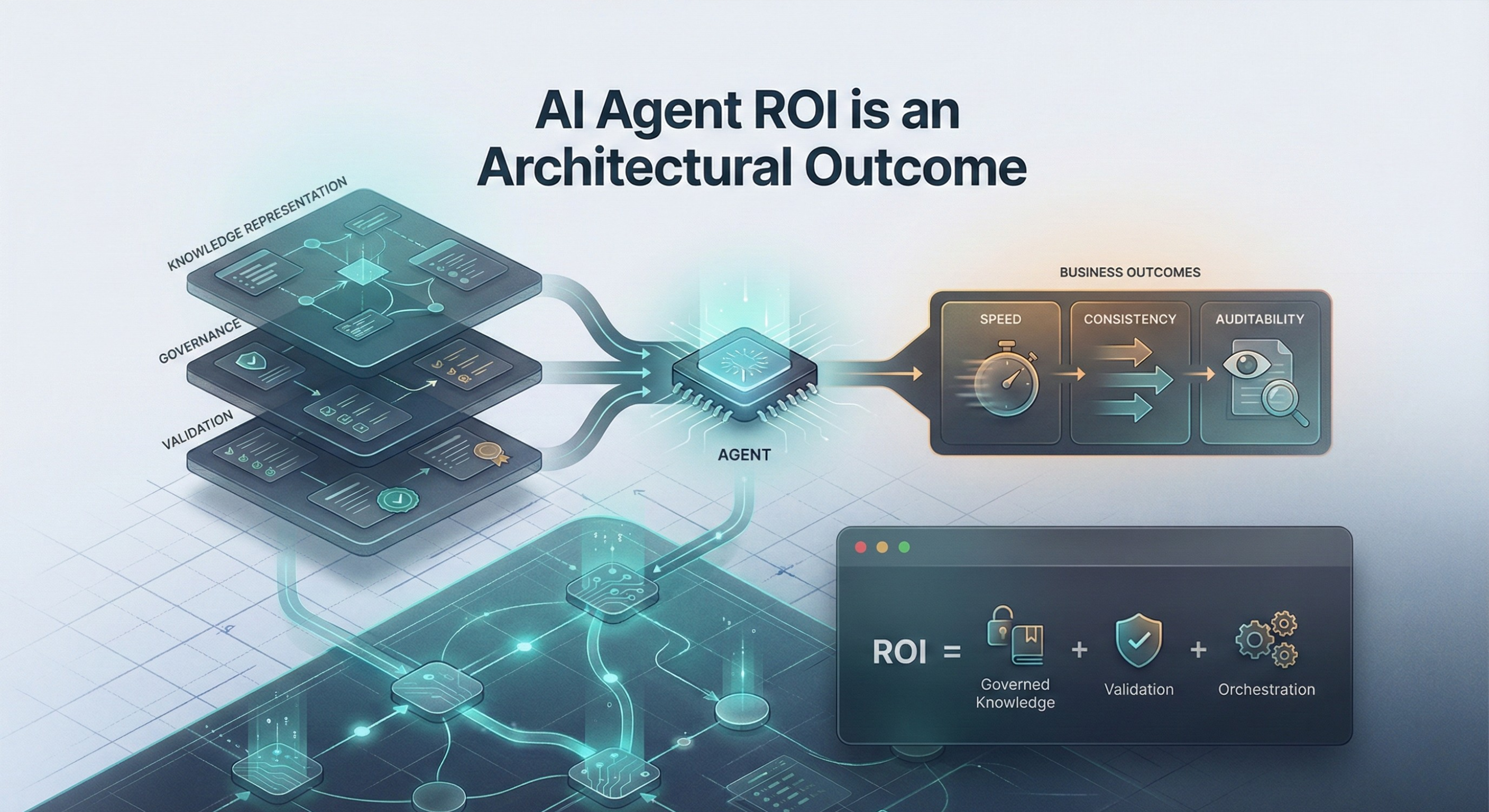
The skepticism surrounding AI agent ROI is understandable. Early implementations have been expensive, unreliable, and difficult to measure. Agents hallucinate. They provide inconsistent answers. They require extensive oversight that negates their efficiency gains. When organizations calculate the cost of errors against the value of automation, the math often fails.
But these failures reflect implementation choices, not fundamental limitations. The agents that fail share common architectural flaws: they operate without institutional grounding, lack access to authoritative sources, and provide no mechanism for validation. They are probabilistic systems deployed in contexts that demand determinism and accountability.
Organizations evaluating AI agents must recognize that model capability alone does not produce durable value. What matters is how intelligence is structured and integrated into existing systems of record, decision-making, and accountability. The difference between an agent that creates risk and one that delivers ROI lies in the foundation beneath it.
Knowledge Graphs as the Foundation for Reliable Agents
Knowledge graph-centric architectures provide a foundation that transforms agent economics. A knowledge graph offers a governed representation of facts, entities, relationships, and constraints that reflect how the institution understands its own domain. This structure creates a shared substrate that both humans and AI systems can reason over consistently.
When AI agents are grounded in a curated knowledge graph, their role shifts meaningfully. Rather than recalling information probabilistically, agents reason over explicit relationships. They navigate institutional knowledge in a way that mirrors how decisions are expected to be made. This alignment between representation and reasoning reduces variance and increases reliability.
ROI changes when agents can only use governed knowledge. Hallucinations drop because reasoning stays inside known relationships. Consistency improves because the same query yields the same answer. Error costs fall because outputs can be validated against authoritative sources before they hit operations.
This architectural grounding enables reasoning paths to be examined and understood. Each step in a decision process can be traced through known entities and relationships. When agents make mistakes, those mistakes are diagnosable and correctable at the structural level. AI systems become explainable participants in enterprise workflows rather than opaque risk vectors.
Confidence scoring adds operational control. Agents can indicate when an answer is well supported versus when escalation is required. High-confidence outputs proceed automatically, while low-confidence cases route to human review—aligning oversight with real risk.
For higher-stakes decisions, agents should operate within predefined controls and escalation paths. When thresholds are reached, actions are routed through established workflows or human approval.
Measurable Business Outcomes
Together, these architectural elements create measurable business outcomes that justify investment.
Decision cycles accelerate because relevant knowledge is surfaced with context. Agents provide grounded answers in seconds—reducing time spent searching across systems or escalating routine questions in service, operations, and compliance workflows.
Human effort shifts from rework to judgment. Employees focus on decisions that require expertise rather than correcting inconsistent information or reconciling conflicting sources.
Compliance and audit processes benefit from transparent reasoning paths. Every agent interaction can be traced to source material. Reviewers spend less time questioning outputs and more time validating business logic. Audit preparation time decreases measurably.
Institutional memory becomes durable because it is encoded structurally. Knowledge does not disappear when employees leave. Onboarding accelerates because new staff can query the knowledge graph directly. Training costs decline as guidance becomes accessible rather than tribal.
Error costs decrease as consistency improves. When agents provide the same answer to the same question regardless of who asks or when, operational variance declines. Customer experience stabilizes. Rework decreases. The cost of inconsistency-often hidden but substantial-is reduced systematically.
Value That Compounds
Over time, this value compounds. Each new application builds on the same knowledge foundation. Improvements in one area strengthen the system as a whole.
This is the ROI difference between off-the-shelf agents and architecturally grounded ones. Standalone deployments often create recurring cost without strengthening institutional knowledge. Architecturally grounded agents, by contrast, build durable enterprise assets that improve with use. The knowledge graph improves with use. Access controls mature as the institution refines governance. Reasoning patterns become more sophisticated as relationships are clarified.
AI agent ROI emerges as a property of system design. It reflects the strength of the knowledge substrate, the clarity of governance, and the discipline of orchestration. Organizations that invest in these foundations are building intelligence that scales with confidence and endurance.
Architecturally grounded agents are easier to trust and easier to measure.
Cognetryx designs and deploys agentic systems on governed knowledge graph foundations, aligned to your existing systems of record and governance.
If you want to evaluate whether this approach fits your environment, we can walk through the architecture and the deployment path together. Let's start a conversation.
Request a Demo